Sinodendron cylindricum, the Horned Stag Beetle
Lucanidae, what a fantastic family of beetles. They are one of my very favourite families among the Coleoptera! Known by the common name of stag beetles, the beetles within this family are perhaps arguably one of the most iconic and readily-recognisable of among the Coleoptera, with over 1200 known species described.
Even for those who have sadly never experienced the joy of encountering any of these animals face-to-face for themselves, they likely still know of and recognise the heavily armoured hexapod delights, the adults proudly possessing an iconic pair of highly specialised and sexually dimorphic mandibles.
As is widely known, male stag beetles possess much larger and more pronounced mandibles in comparison to the females. These often huge mandibles are used to lock into and wrestle with other male stag beetles in trees (with the intention of gaining purchase on and flinging their opponents away), competing with each other over food sources (such as tree sap), potential mates and territory. Some species, such as Prosopocoilus giraffa (pictured below; it is the largest described species of Lucanid in the world!), are markedly large in size and possess some extremely long and powerful toothed mandibles.
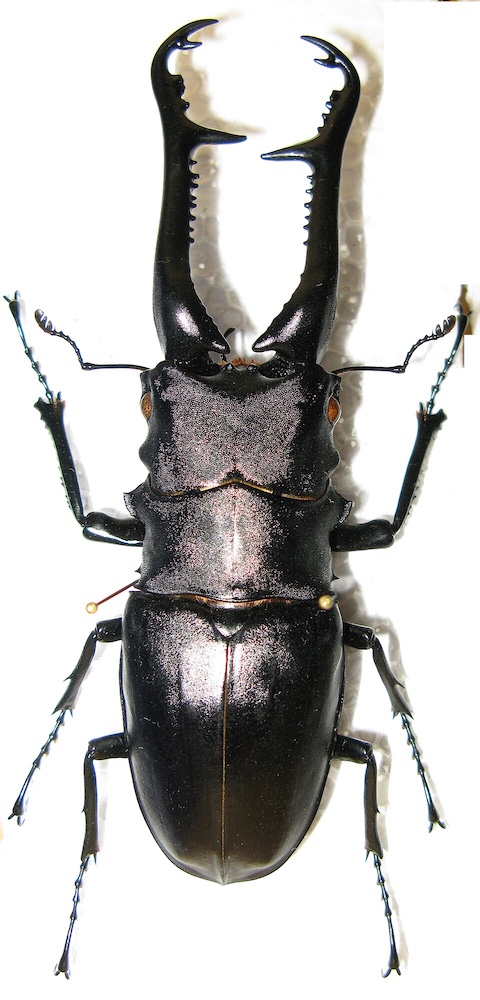
A male Prosopocoilus giraffa specimen.
Image by Wikimedia Commons user Anaxibia, 2010. (Source)With this in mind, in spite of these morphological traits being so inherent to the vast majority of species within the Lucanidae family, there are in fact a small number of species that are conspicuous among their closely-related Lucanid relatives. Today I will be discussing one particular anomaly amongst the Lucanidae family…

Image by Wikimedia Commons user Siga, 2010. (Source)
Enter Sinodendron cylindricum, a rather peculiar little stag beetle that, as you can see above, could on initial sight be quite readily mistaken for a member of the Dynastinae (rhinoceros beetles); that pronotum after all has something of a resemblance to that of rhinoceros beetles in the genus Oryctes! Indeed, with a prominent horn structure on the heads of the males (with it being absent in the females) and an absence of the specialised and pronounced mandibles so typical of the Lucanidae, the form and function of this horn is indeed highly comparable to that of the the rhinoceros beetles; this horn is indeed used to wrestle and joust other males of the same species to compete for resources such as food or potential mates. S. cylindricum is one of three described members of the Sinodendron genus, the other two species being Sinodendron persicum and Sinodendron rugosum.
In spite of the morphological and behavioural deviations from the more conventional stag beetle species, this lovely beetle is phylogenetically a member of the Lucanidae family regardless, belonging to the subfamily Syndesinae. The larvae of the species, being pale C-shaped grubs with red to brown heads and short legs, otherwise undergo the same variety of life cycle as other stag beetles. Following a pair of adults successfully mating, the fertilised eggs are oviposited into rotting hardwood logs or stumps. The larvae reside within and feeding upon the rotten wood until they undergo pupation. Following the eclosure of the adult, the beetle emerges from the log or stump, now in its elegant and delightful adult form. The adults are capable of flight and feed upon tree sap.
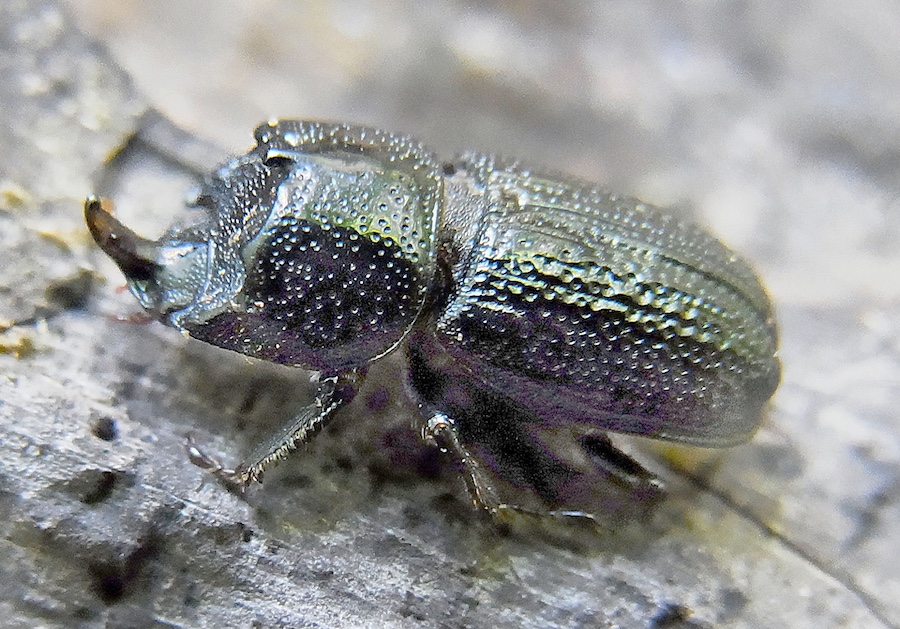
Image by Wikimedia Commons user Siga, 2010. (Source)
Sinodendron cylindricum happens to be one of three* stag beetle species inhabiting the mainland of Britain, the other two species being Lucanus cervus and Dorcus parallelipipedus; both of these species are certainly much more characteristic of the more conventional Lucanidae, with the typical sexually dimorphic mandibles found in the adults. The distribution of S. cylindricum has quite a far-reaching distribution across Europe and Asia, ranging from Ireland and Britain to continental Europe, extending as far east as western Siberia.
In the UK, S. cylindricum possesses the very apt common name of the Horned Stag Beetle (in addition to the less common Least Stag Beetle). There are not any endemic species of rhinoceros beetle found in mainland Britain, but I say this fascinating little beetle more than makes up for that with the niche it occupies. How wonderful indeed!
*Notably, there is an extinct fourth species of stag beetle that has been historically been reported as once endemic to the mainland of Britain, Platycerus caraboides. The species is classified as being extinct within the locality of Britain, with the most recent sightings of confirmed live specimens seemingly being recorded in the 19th century.Click here to return to the Bugfox Biology Writings archive!